
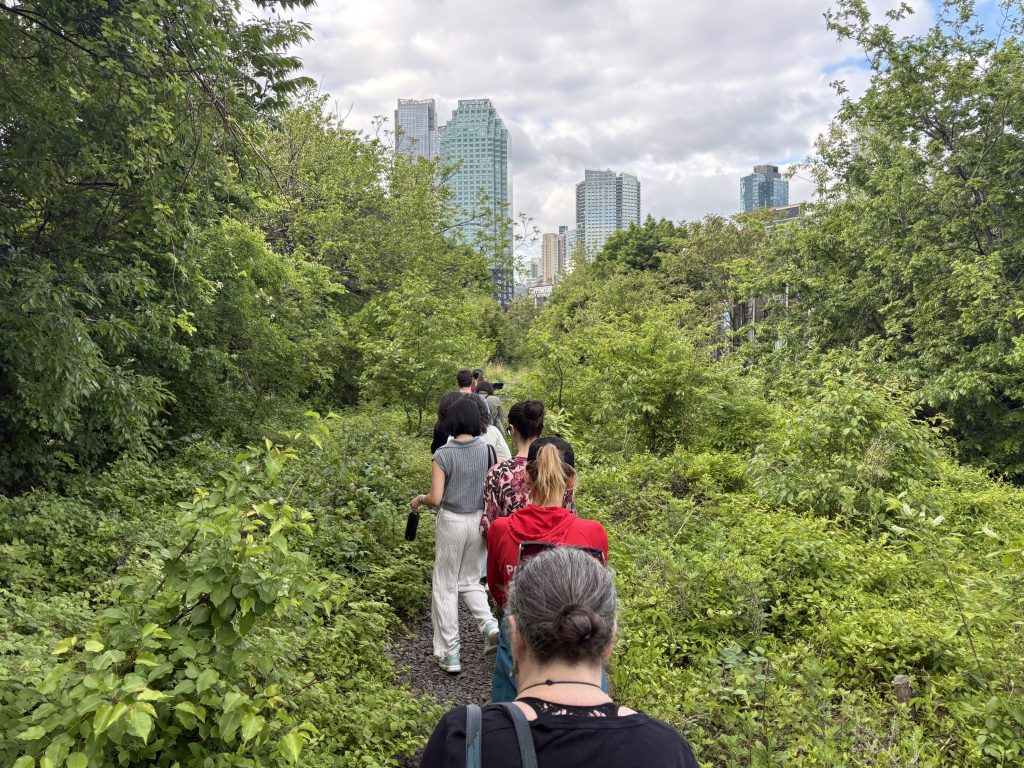
On May 15, 2026, Newtown Creek Alliance led a guided tour of the Dutch Kills Loop, one of the five tributaries that make up the Newtown Creek watershed. The walk invited participants to explore the challenges and opportunities along Dutch Kills, from combined sewer overflows and deteriorating bulkheads to ecological restoration projects and emerging visions for public waterfront access. Along the way, participants learned about NCA’s advocacy efforts to reconnect one of the city’s fastest-growing neighborhoods to a restored wetland waterfront and continuous green loop.
We began at the Hunters Point Avenue station, where participants were introduced to NCA’s mission to restore, revitalize, and reveal one of the nation’s most polluted waterways. The opening discussion connected Dutch Kills to broader watershed-wide efforts around environmental remediation, habitat restoration, and equitable access to green space. From there, the group traveled through Long Island City’s industrial landscape toward the embankment entrance of the Montauk Cutoff, a decommissioned rail line owned by the MTA. Once an active freight corridor, the abandoned right-of-way now offers a glimpse of what could become a key segment of a future Dutch Kills Loop greenway. NCA staff shared how the corridor could support native habitat, improve connectivity, and provide much-needed public open space in a rapidly developing neighborhood. The group continued along the tracks before arriving at Smiling Hogshead Ranch, the community garden that has flourished at the northern end of the Montauk Cutoff since 2011.
The tour then continued toward the 29th Street street end, where participants discussed the lack of public waterfront access along much of Dutch Kills despite its proximity to dense residential development and institutions such as LaGuardia Community College. NCA staff highlighted the potential benefits of direct waterfront access for education, research, stewardship, and recreation while also explaining how abandoned and unclaimed sunken barges continue to present obstacles to restoration efforts and public access improvements.
As the walk wound through Long Island City’s industrial corridor, participants engaged with NCA staff on a range of topics including habitat fragmentation, freight movement, and the complex relationship between industrial activity and environmental health. These conversations underscored the interconnected nature of NCA’s advocacy work and the many challenges facing communities along the Creek.
The group eventually arrived at the Borden Avenue street end, where participants learned about the transformation of the site following a tragic traffic fatality in 2021. What was once an underutilized waterfront edge has since been reimagined as a pocket park featuring pollinator pathways, bioswales, tidepools, and native plantings. We discussed how these restoration strategies improve stormwater management, support biodiversity, increase climate resilience, and create safer, more welcoming public spaces.
The walk concluded at Kingsland Wildflowers with a discussion of a long-term vision for Dutch Kills and Newtown Creek. Participants reflected on the importance of restoration, stewardship, and advocacy in creating healthier waterways and more connected communities. The tour served as a reminder that even in heavily industrialized landscapes, there are opportunities to restore ecological function, expand public access, and build stronger relationships between people and the waterfront.